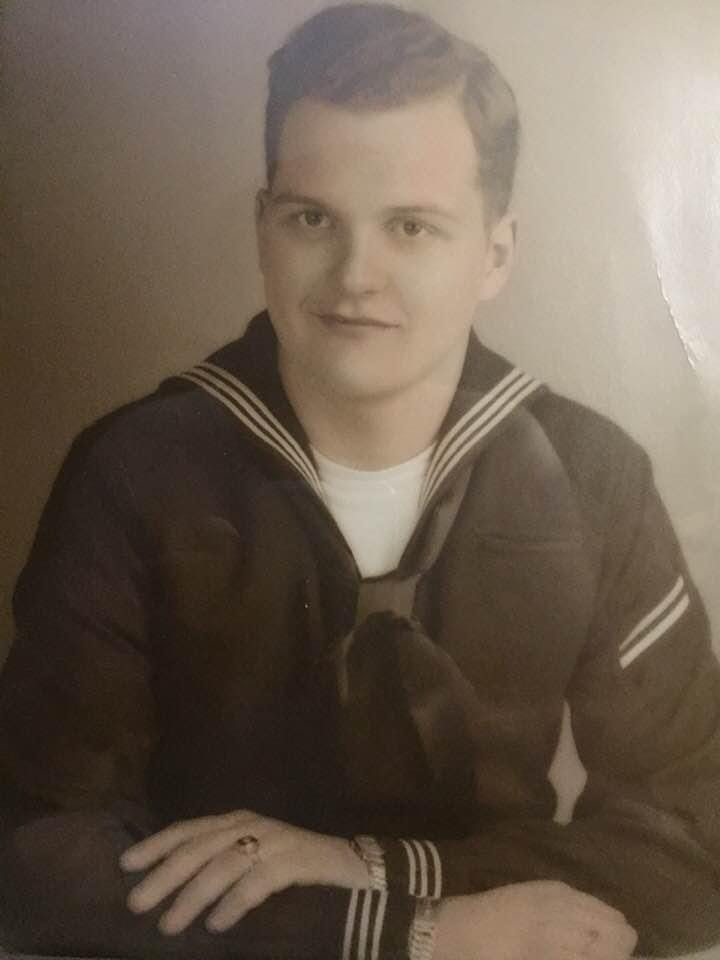
My father hated bullies and bigots. Hated them. It wasn’t a case of a working-class white man born in 1930 undergoing some kind of enlightenment. It was an instinctive disgust with cruelty and unfairness. That doesn’t mean that he didn’t have encounters that reinforced that instinct. When he was in the Navy in the early ‘50s in Newport News, Virginia, he got up to give a bundle-laden Black woman his seat on the bus. She refused and the other White people on the bus told him that he had no business doing that. As encounters with racism go, it was far less worse than things he could have seen in that place in those years and I think he would have been the same person if he hadn’t seen it. But he never forgot it. A few years later, talking to his old-school Bible-thumping grandfather Dad asked him if he believed he’d stand before Jesus when he died. Speaking from that rectitude that has no doubt of its own righteousness, his grandfather didn’t hesitate to answer, Yes. Well then, my Dad continued, when he asks you if you’ve loved your fellow men and you tell him yes, what are you going to say when he asks why you spent so much time running down Black people. The old man shut up.
My father loved his years in the Navy (he signed up to avoid being drafted for Korea). He didn’t see action but he did see the world—Tunis, Naples, Madrid, Cannes, and his favorite, Istanbul. He often talked about how he wished he’d reenlisted, though my mother and I were glad he didn’t. At his graveside, when a serviceman handed me the flag he and a colleague had just folded, “on behalf of the President of the United States and a grateful nation,” I knew Dad would be proud of the latter and loathe the former. There are only a few things I regret my father not getting a chance to do and a few things I regret he had to experience; one is that a man who was an instinctive democrat died with this pustulent as president.
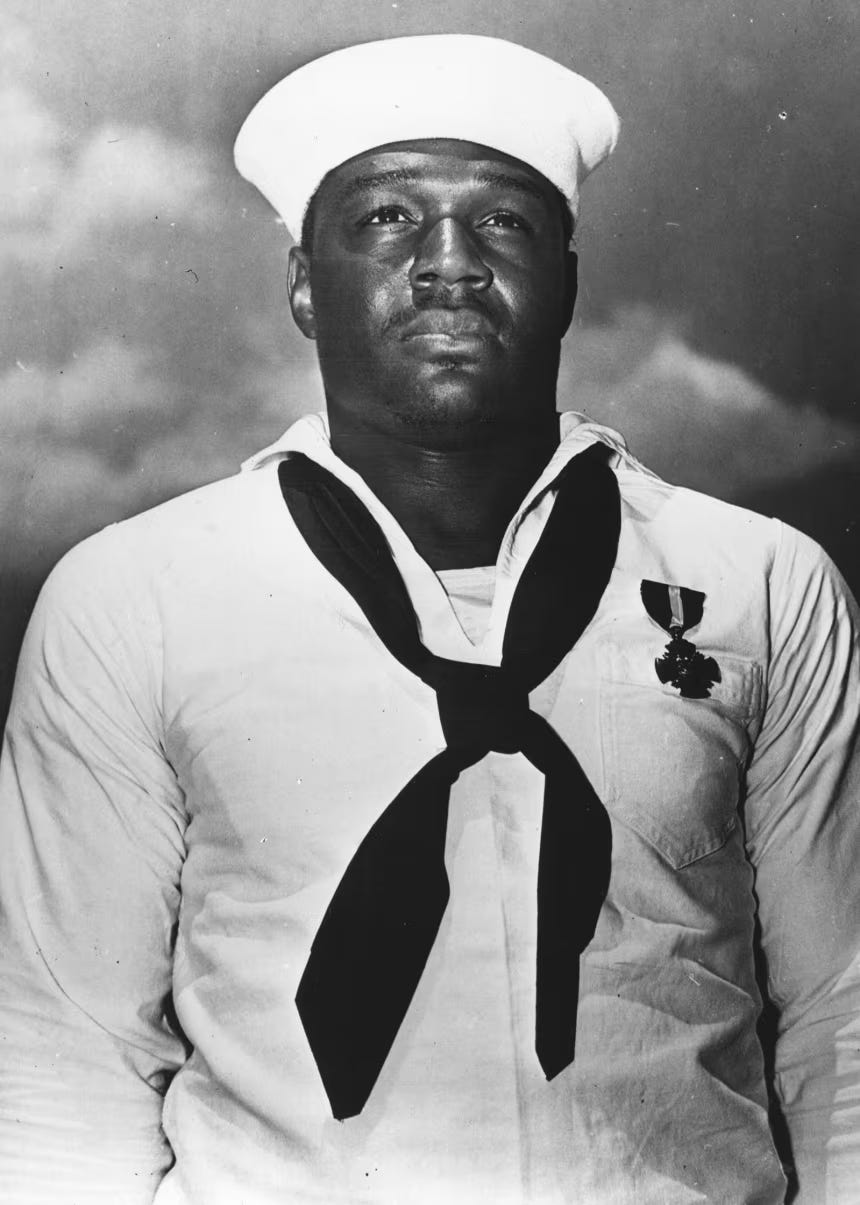
My friend Barb, who loved my Dad (since his name was Charlie, too, she always calls him Big C), pointed out this week that he’d have hated what the Department of Defense (I’m not calling it the Department of War because Trump wants to cosplay soldier) is now doing to the family of Doris “Dorie” Miller. Miller was a Mess Attendant Third Class on the U.S.S. Arizona which was stationed at Pearl Harbor in December 1941. When the Japanese attacked Miller couldn’t get to his battle station but aided wounded soldiers, including his CO, and took control of an anti-aircraft gun, on which he’d had no training, to fire at incoming Japanese planes. He fired until he ran out of ammo and helped sailors to shore as the Arizona sank. He was given the Navy Cross by Admiral Chester Nimitz in 1942 and, almost a year after Pearl Harbor, was killed by a Japanese submarine attack.
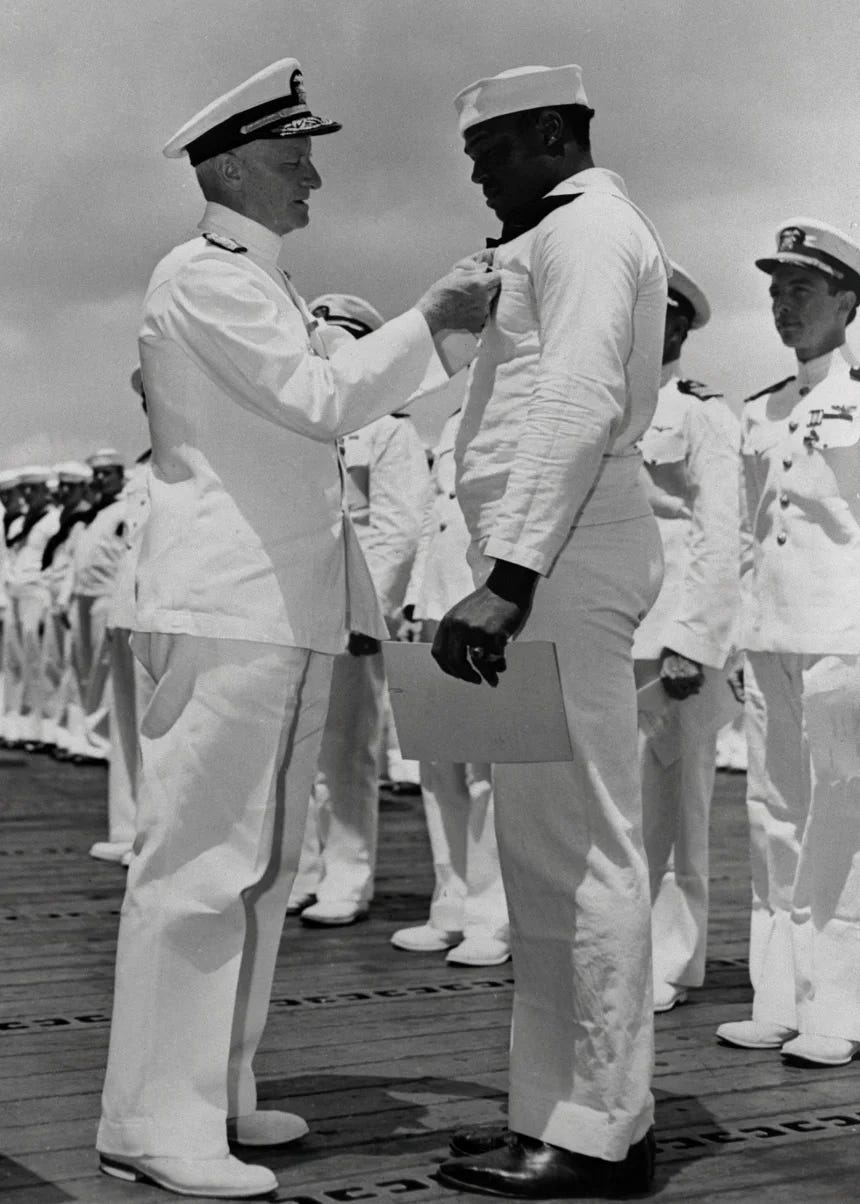
The Navy had intended to name an aircraft carrier under construction for Miller. This past week his family found out (but was not informed by the Navy) that under the direction of Pete Hegseth the ship is being named for Trump instead, something that has never been done for a sleeping sitting president, and certainly never been done for a draft dodger. Of course the only reason Hegseth is seeking to do this is because Dorie Miller was Black. Which is the only reason he has sought to wipe the histories of Black military heroes (including Jackie Robinson) from websites and to rename bases after traitors—though Hegseth claims that places like Fort Bragg and Fort Benning are now merely honoring serviceman who just happen to have the same last name as the Confederate scum the bases were originally named for. The claim is that this is an attempt to get rid of DEI initiatives, which is a convenient cover for the transparent White nationalism of Hegseth and the trash he works for.
The Navy my father served in and the country he served for had, at the time he was enlisted, not begun the still-unfinished reckoning with race that would emerge into the national consciousness in 1956, a few years after his service ended. The yearbook for his ship, the U.S.S. Yellowstone, shows his black colleagues segregated into one group, even though Truman had ordered the armed forces to be desegrated in 1948. Dad remembered a hot day in Virginia where a CO ordered him and a few other sailors to stock a jeep with hot dogs and beer and soda so they could have a day at a local beach. When the CO told a Black sailor with them that he couldn’t go because it was a segregated beach, everyone refused to go and instead they took the afternoon off hanging out together on base.
My father, unlike my mother (and unlike me as I inherited my temperament from her) had a long fuse. It took a lot to get him mad. I know of only one instance, before I was born, where he threw a punch (it was directed at a district manager for the supermarket chain he worked for and came after the d.m. had repeatedly demeaned him; anyone who has ever worked retail knows that most people drawn to the role of district manager would benefit from regular punches to keep them in line). But nothing made his blood boil like bullies and bigots. Giving my Dad’s eulogy, his pastor, Chris, who did more for my parents during their last years than I will ever be able to repay, said of him, “Charlie hated the way we treat black people in this country. He hated the way we treat gay people.”
It’s part of what has demeaned this country, demeaned us all, that had he not died in 2017, this essentially loving and generous man would have found plenty to hate about the country he once served. Certainly smug, greasy Pete Hegseth, is just the sort of bullying coward on whom my father would have wished a beatdown. If America is to be America again, as Langston Hughes wished, the national restoration that must follow this era of moral catastrophe—but is not guaranteed—has to be more than assigning fitting names to aircraft carriers and Army bases. It has to mean honoring men like Dorie Miller by making and preserving a country worthy of them.